
The Royal Society of Sculptors has grown substantially since it was first founded in 1905, going from a membership of 51 to over 750. The majority of our members make a lifetime commitment to the Society, and we are delighted to celebrate Fellows who have been with us for 40 years or more!
Born in London, Dawn Rowland FRSS has lived and worked in San Francisco, Manchester and is currently based in London. Her sculptures are primarily carved in stone, but she also works in bronze, plaster and clay. In her work she explores the interdependency and fragility of human relationships.
She has been interviewed twice on BBC’s “Women’s Hour”. In 2004 discussing her poignant monumental sculpture commissioned by Nicola Horlick and in 1988 regarding her three carvings exhibited at the Royal Academy Summer Exhibition.
She was presented to the Queen at the opening of the international exhibition “Chelsea Harbour Sculpture 93”. Elected a member of the Society in 1991, she was made a Fellow in 1994. She has served on Council several times. Having exhibited in Europe and Japan, her works are in private collections in Europe, Japan, the United States, Australia and Canada.
WHO WAS THE FIRST PERSON TO ENCOURAGE YOU TO BECOME A SCULPTOR? WHAT DID THEY SEE IN YOU?
No-one really encouraged me to do sculpture. Born 1944 in London, I lived with my twin brother, parents and grandparents. I was good at art in school and always wanted to go to art school but due to my family’s financial situation, I took a secretarial course. In 1965 my husband Malcolm and I married and went to San Francisco for his post-doctoral studies and stayed 10 years. I worked in the city and took life drawing classes after work. When our daughters were young, I was invited to a charity 'clay in', a lunch in aid of the Marin Symphony. Instead of making cakes we were provided with balls of clay and told to do anything we wanted. I started making clay sculptures in the evening and would have them fired locally.
In 1973 we returned to London for a sabbatical year and I started life sculpture at Camden Art Centre in Hampstead. At the end of the year, they held a two week stone carving course. This changed my whole life. I remember the overwhelming joy of putting a chisel in one hand and a mallet in the other, and hitting the stone. Sculpture had found me.
On returning to California, I worked in a sculpture atelier under a New York Sculptor, before moving back to Manchester for my husband’s professorship. I heard about the Manchester Academy of Fine Arts and put my sculpture forward for their Annual Exhibition at the City Art Gallery. I was thrilled when my sculpture was accepted. Everything from then on has been the icing on the cake.
I became a member and then served on the Council of the Manchester Academy of Fine Arts. I created my first studio in the garden in Bramhall, surrounded by the trees of Bramhall Park.
When I was elected a Member of the Royal Society of Sculptors, I was so thrilled and excited. At my first member’s meeting I couldn't believe I was in the company of so many revered and eminent sculptors. Becoming a Fellow of the Society, and serving on the Council for many years, has been a fabulous journey. Additionally showing my work at their international exhibition in Chelsea Harbour and being introduced to the Queen was an amazing honour.
I now spend my days living in London and working in my studio and will be forever grateful to the Royal Society of Sculptors for all they have helped me with over the years. I still can’t believe what started in California at a charity lunch, with a small ball of clay, has become my life's work and passion.


WHO WAS YOUR MOST INFLUENTIAL TEACHER?
In 1975, we returned to California for a year. I wanted to find somewhere to carve and found a morning atelier run by a New York sculptor called Guy Swartz. He was the nearest to a teacher that I have had. He was always there to give advice and guidance and realised how much I wanted to carve. The first sculpture I made was in pink alabaster and very reminiscent of the style of Henry Moore. Working the stone made me realise even more that this was where my life was going. Guy was so encouraging and he told me he really believed I had the potential to become a really good sculptor.
WERE YOUR PARENTS ARTISTIC?
My parents met on a blind date and married in World War Two.
My mother Zena grew up in the East End and worked as a seamstress in the sweat shops, but told me she always had a dream of a better life. She said that during the Blitz she would go into central London to smart hotels and watch how they set tables and how people dressed. She made all my clothes and when I drew or showed her a photo of a dress, she was able to make it without a pattern. She knew how much I liked drawing and when I was 15, enrolled me in my first life drawing class and when I got engaged encouraged me to go to Cordon Bleu after work. She made my wedding dress when I got married. I designed it, and she made it. She quilted and embroidered leaves for the apricot ribbon roses and the dress was made with love in every stitch. I nearly forgot that, at nearly 90, she started to paint beautiful landscapes even though she suffered from macular degeneration. My mother definitely had untapped artistic talent. I am totally convinced that ‘in a different time and in a different life' she would have put her hand to any artistic endeavour that she wanted.
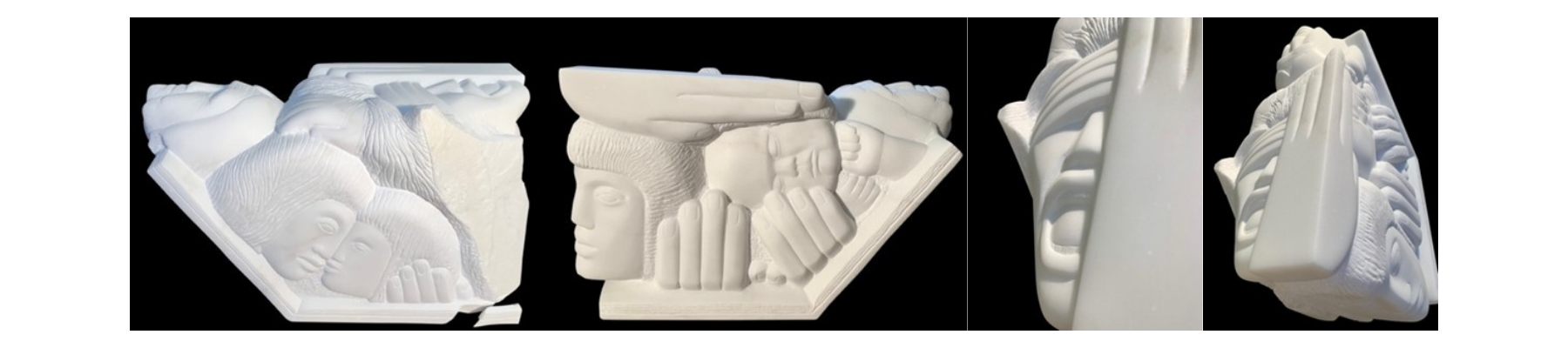
My father Isi was a holocaust survivor. As a child, when we discussed his childhood, he told me how poor they were and how he went to work at 11 to pay the family’s rent. He was born in England but grew up in Antwerp. As Jews, he realised his family needed to leave Belgium so in 1939 with his mother and 5 of his 6 sisters, who had British passports, managed to get on the last boat to leave for England. His father waited for his brother which proved a tragic mistake as the Nazis moved into Belgium and both were sent to Auschwitz where they were murdered with millions of Jews. My dad often told the story of a cousin, who was sent to Auschwitz but escaped from there, helped by a Polish farmer. When the Iron Curtain fell, they found the farmer and brought him to Los Angeles as a ‘righteous gentile’. I grew up with all these stories from my father’s past. My father taught us that everyone was equal, all religions and colours and we were not allowed to buy anything from South Africa because of Apartheid and Spain because of fascism. He always wanted to go to live in Israel but my mother would not go. Although my dad was not artistic our family history resulted in my creating two holocaust sculptures and very recently a sculpture, called “The Story Never Ends” (below, statuario marble) about the women who were raped and the young women, the old women, the mothers, children and babies abducted by Hamas on October 7th.
HOW DID THE MARKET RESPOND TO YOUR WORK?
My first one-woman exhibition was in Salford City Art Gallery in 1984. Before that, I had met Wendy Levy of the Pitcairn Gallery, Knutsford and my first joint exhibition with her was in 1982. It was hugely successful and one sculpture was even taken to Los Angeles. For all these years, Wendy has been one of my biggest supporters. She closed her gallery in Knutsford and re-opened a new one, Wendy J. Levy Fine Art in Didsbury, and I have exhibited there many times throughout the years, but our most successful exhibitions were held, under the umbrella of her gallery, in my home and garden.
As so many potential buyers were under the impression they wouldn’t have room for a sculpture in their homes, Wendy and I decided to put on home exhibitions showing how easily sculptures can ‘live’ in a home environment. At that time, I had a large garden with Bramhall Park as a beautiful backdrop; we would put the larger pieces in the garden and the drawings and sculpture in the house and studio. These exhibitions ran very successfully for many years.

WHAT WAS YOUR BIGGEST OBSTACLE AND HOW DID YOU OVERCOME IT?
My biggest obstacle as a sculptor has been a fight between my two great loves: my family and my sculpture. One way to overcome this has been having my first studio in my garden in Bramhall and, now my second, within walking distance of my home in London.
As a sculptor, a wife and a mother, it has been very difficult at times to successfully marry the amount of time I give to each of these parts of my life. In many ways, it has sometimes been an impossible task but at other times has led to creating sculptures which express this conflict. I have expressed these feelings by creating series which reflect periods in my life which have affected me as a woman. Series such as Letting Go, The Warrior Dreams, My Sister… Myself: Balancing Heads, The Silent Scream dealing with those teenage years, An Emotional Year, the year my father died and Boxed In a series which starts with being totally bound by the box, and which ends with Free Again coming out of the box but still bound to it.
In my eighties, I am still carving but unexpectedly once again trying to deal with the problem of time in my studio. Not because of old age, which should not be a detriment to working if you are still reasonably strong and healthy, but because of family health issues which now exist.

DID YOU DEVELOP YOUR PRACTICE IN SOLITUDE OR WITHIN A GROUP?
As a direct carver, I have always worked completely alone with just some classical music in the background to keep me company. I did, however, spend one month working in a Pietrasanta sculpture studio to get the feel of working in the place marble is quarried.
Over the last years, through participation in the Royal Society of Sculptors, I have enjoyed watching young women sculptors who have not been as constrained as some of my generation and noticed how they have bloomed and grown in confidence. I wanted to express this in my marble sculpture So Much More than we were Before.

DID YOU DREAM BIG OR DID ‘BIG’ SCARE YOU?
I was never scared of, and always wanted to, work on bigger sculptures. But to work big I decided I needed a fork lift. At a trade fair, I met representatives of a fork lift company who were exhibiting and we discussed visiting their factory to see what I might need. Firstly, they came to look at my studio and then drove me to the factory and showed me a rather impressive fork lift. They explained the controls and let me drive it. When I got down, they said now that you have that out of your system, let us show you what you really need. A little less impressive, and more like a stacker truck it did lift 3+ tonnes. They were absolutely right, of course, and I bought it and still have it now, after all these years, in my London studio. I have used it for all my larger sculptures. There is a little red button on the handle to make sure it stops when it comes into contact. Once, when I was in a hurry and not thinking I reversed it badly with the handle to the side. It didn’t stop and pinned me to the wall with luckily only bruised ribs: that never happened again!!
WHAT IS THE BEST THINGS A CRITIC HAS SAID ABOUT YOU?
This is a hard choice because I have had quite a few lovely ones, but my favourite has to be when I had an exhibition in Kyoto, Japan. This is what the Kyoto Sinbun Newspaper said about my exhibition. I always smile when I read it.
The figures of head, face and hands were engraved in the marble. While it seems that she is inspired by the sculpture culture in Africa, the charming point of her sculpture is the powerful expression of the poetical sentiment which should be considered as the root of existence of human being. The affection between parents and child, the horrors of war, love and sadness could be felt as dream and poetry hiding behind this work.

WHAT IS YOUR FAVOURITE COMMISSION /SCULPTURE?
My favourite, and most emotional, commission has to be one to carve a 3-tonne sculpture about a young girl, Georgie, who had leukaemia from a young age and who tragically died at 12 years old. Her mother Nicola Horlick wanted me to make a sculpture to celebrate her daughter’s life and liked the fact that I carved hands. She gave me many photos of her daughter and we discussed the sculpture at length. Georgie, she said had lovely hair and described it as 'sunshine'. I often carve blindfolds to depict youth or innocence, but Nicola didn't want that as she felt her daughter had lost her innocence much too young. I decided to carve two hands, one hand depicting the mother and the other the father and then joined Georgie to her parent’s hands. As a direct carver, I do not make maquettes so it was difficult for Nicola to know what I was going to do: it was a great leap of faith on her part. While carving the sculpture, my mother became very ill with a form of blood cancer so it was a very difficult time for me to keep everything going. Half way through the commission, I had a panic attack and kept thinking about Nicola and how very emotional this must be for her. I was so acutely aware of this, that I became paralysed with not wanting to disappoint her. In the end, my husband took me aside and said "either call Nicola and tell her you can't finish it or just DO IT!". This was just what I needed to get my equilibrium back and I went on to finish it. When Nicola came to my studio to see the sculpture, she studied it for what seemed ages and was very quiet.
On the way back from the studio Nicola took my hand and whispered in my ear: "I knew I had the right sculptor!"
Nicola and I went on BBC’s Woman’s Hour to discuss her sculpture and the commission. It was voted one of the top five interviews of the year in 2004.

IS THERE ANYTHING ELSE YOU WOULD LIKE TO ADD?
Lastly, a massive shout out and much appreciation to the Royal Society of Sculptors for their help, friendship and scholarship through the years and for exhibiting my sculpture included in their Chelsea Harbour Exhibition. I have enjoyed every minute of being part of your sculpture family and all I can say is “It’s been a wonderful journey and thank you”.


